
Sustainable Finance
With the built environment responsible for around 15% of Aotearoa’s emissions, sustainable finance is a vital lever to supporting our sector to reduce its footprint.
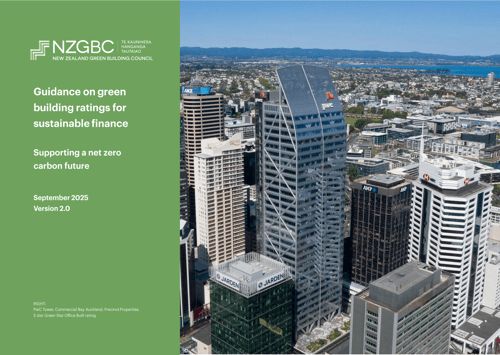
Sustainable Finance Guide
As lenders and borrowers increasingly look to cut emissions and incentivise better buildings, we've released a new update to the guidance on green building ratings for sustainable finance. This guide aims to help the market answer the question ‘to obtain sustainable finance, what is a considered a sustainable building?’
Trusted, third-party verified certifications are used by hundreds of projects each year. Many in the sector are already using Green Star and Homestar for new building projects, and Green Star Performance and NABERSNZ for certifying existing building portfolios as part of green loan and bond mechanisms. This has in turn driven financial benefits and incentivised the property sector to take action to decarbonise their portfolio, use less energy, and build better.
The guide sets out NZGBC’s rating tools including the certification and level of performance that should be expected for certain building types, both now, and in future years as the sector ramps up to improve its sustainability outcomes and contribute to Aotearoa New Zealand's climate goals.
Ongoing updates and consultation
The first version of the Sustainable Finance Guide came into effect in 2024, with version two published in 2025.
With the rapidly evolving market, this guide is reviewed annually alongside stakeholders to ensure it remains fit for purpose and meets the needs of borrowers and lenders.
Thank you to all the stakeholders that took part in the consultation process around each version of the guide.
We are now undertaking this regular review, which occurs in two parts:
1 - An initial survey asking industry and stakeholders what they would like changed/added to the current guide. Suggestions and ideas welcome.
2 - A second feedback survey will then be issued to stakeholders after the NZGBC has processed feedback, drafted proposals for changes and run a webinar about the proposal. This consultation period will be open for a month before the guidance is finalised.
We anticipate the updated guide will be published later this year. Thank you to all the stakeholders that take part in the regular updating of this guide.
Sign up for our webinar here
If you have any questions, please contact Bobby Shen, Impact Manager - Buildings.
If you have questions about our rating tools, including which certification performance level is expected for certain building types please contact us at info@nzgbc.org.nz
Frequently asked questions
Green Star Buildings can verify the sustainability of the design and construction phase of a non-residential building.
Green Star Performance can verify the sustainability of a non-residential building in its operational phase.
NABERSNZ is available for verifying the energy and water efficiency of office buildings and once NABERSNZ certification is obtained, this can be applied to the respective credits in Green Star Performance.
Green Star Communities applications can be used to guide the sustainable development of a large site, thinking about infrastructure, transport, community connection, and other aspects.
Homestar certifications can be used to verify sustainability requirements for residential homes and apartment buildings.
NZGBC’s sustainable finance guide is guidance about what the NZGBC rating tools offer in relation to what a lender may define as a “green building”. It is not legal advice and NZGBC does not provide endorsement of any particular lender or provide any assurance that finance will be provided in accordance with any guidance.
For anyone seeking sustainable finance, we believe that our independent rating tools set out market tested and achievable targets to aim for and to bring to your financier or investors.
Within the Green Star Performance tool, credit 15 is the ‘greenhouse gas emissions’ credit, more commonly known as the ‘energy’ credit since it is only focussed on emissions from energy use in the building. This is a key metric in the NZGBC Sustainable Finance Guide.
To verify the score (out of 20 for base building ratings and out of 23 for whole building ratings), please request that the credit 15 score is added to the certification letter.
For office buildings, NABERSNZ is the first port of call. This can rate energy and water efficiency for office buildings only. If an office building is wanting to pursue a Green Star Performance rating, then the order of priorities with the energy and water credits is that a NABERSNZ rating is used to obtain points. However, this might not be the case if there is some reason that a NABERSNZ rating can’t be obtained.
For buildings that don’t have a NABERSNZ tool available (e.g. supermarkets), Green Star Performance can be used to rate the energy and water efficiency of all non-residential buildings (if they are eligible). It can also rate more than energy and water – looking at transport, indoor air quality, policies and more.
NZGBC does not have a position on this. Even though the requirement in our guidance steps up with each year band to incentivise increased ambition, it may be disruptive to a loan/bond structure to have the requirement move mid-term.
The NZGBC website has a list of current ratings. If the rating is expired or the building owner has opted to not disclose their rating on this database, then it won’t be present here.
https://nzgbc.org.nz/nabersnz-rated-buildings-table
The best way to make sure there is a current NABERSNZ rating is to request the rating certificate and rating report from the building owner.
NZGBC recommends that new buildings that obtain sustainable finance using Green Star should verify the operational performance of that building in the following years, to satisfy the criteria outlined in the Guide. We recommend rating with existing building tools (NABERSNZ or Green Star Performance) as soon as possible before any deadline to understand how the building is performing which may reduce the risk of not meeting criteria. NZGBC can only confirm an application or a final certification. It is up to the party providing finance to determine financing deadlines and criteria.
From 30 September 2026, three new NABERSNZ will be available in New Zealand: NABERSNZ Energy for Shopping Centres, NABERSNZ Energy for Warehouses and Cold Stores, and NABERSNZ Energy for Retail Stores. These tools were adapted from the already available NABERS tools in Australia.
NZGBC will be undertaking its periodic review of the NZGBC Sustainable Finance Guide to consider adding thresholds for ratings under these tools. This is likely to be published at the end of November.
For the interim, financiers may want to look at the standard NABERSNZ star rating definitions or precedents that set thresholds for these tools, eg:
- The latest version of Australia’s NABERS Sustainable Finance Criteria. Version 2 was released in July 2025.
- GBCA also has a guidance document for sustainable finance across all tools – page 38 on the PDF covers their recommended thresholds for building operations.
- The Australian Taxonomy includes some of these tools as proxies.
As with any guidance, it is at the financier’s discretion what threshold is appropriate for their particular case.
To clarify the guidance, the two columns - ‘minimum certification for construction’ and ‘minimum certification for operational performance’ - were not intended to be compounding criteria. Financiers may want to use one column or the other depending on what phase of the building they are trying to finance. Financiers should consider the particular circumstances on a case by case basis.
The principle of this guidance is to maintain accessibility to sustainable finance incentives for buildings that can demonstrate high operational performance but may have not obtained Green Star certification at the design and construction phase.
