

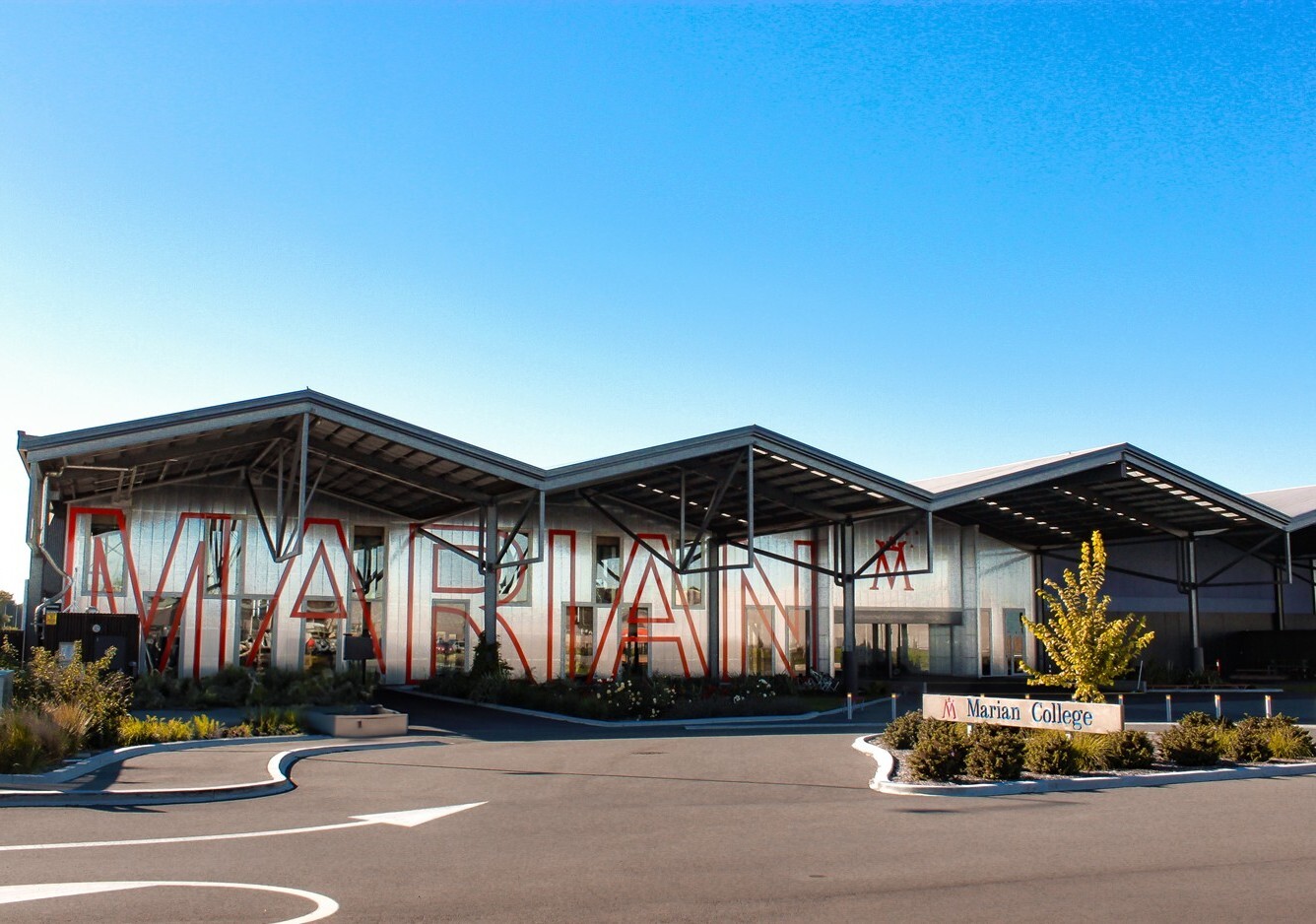
School buildings are not often the domain of boundary-pushing design solutions.
But 4 Star Green Star rated Marian College in Ōtautahi Christchurch showcases breathtaking building reuse.
Essentials
Name: Marian College
What: a disused 17,000 square metre industrial warehouse on a three hectare site reinvented as a contemporary high school; a Catholic state integrated school for girls Year 9 to 13
Details: 10,000 square metre built form; six two level classroom blocks (26 classrooms); a chapel; atrium spaces; administration zone; pastoral care spaces; library; four multi-use indoor courts; performing arts theatre, interior and exterior gathering spaces
Name: Marian College is named for Mary, mother of Jesus. Ngai Tuāhuriri gifted the name Māhutonga to the school referencing the Southern Cross, the journeying of the school’s founding catholic sisters and its post-quake pathway
Daily occupancy: 430 students and approximately 50 staff
Address: 2 Lydia Street, Northcote, Christchurch Ōtautahi 8052
Project Snapshot
Owner: Catholic Diocese of Christchurch
Architect: Sheppard & Rout
Project GSAP: Powell Fenwick
Project status: site purchased early 2019; construction phase October 2021 to November 2023; official opening February 2024
Project certification: 4 Star Green Star Design and As-Built NZ v1.0 Built rating (July 2025)
When Marian College opened its doors at the commencement of the school year in 2024 it marked a homecoming.
Forced from its original site in the Christchurch suburb of Shirley following damage sustained in the February 2011 earthquake, the school spent 13 years in temporary accommodation in two different locations.
With eyes focused on the need for a permanent solution a decision was made to relocate to the northwest side of Christchurch with close proximity to neighbouring Catholic schools.
Two years on, the new iteration of Marian College delivers well beyond the scope of a long-desired and enduring home.
It’s a showstopping exemplar of highly ambitious adaptive reuse – a secondary school housed beneath the canopy and form of a defunct, large-scale industrial warehouse.
The school sits in its suburban landscape as a striking educational campus defined by architect Joff Kennedy from Sheppard & Rout as “a fascinating spatial strategy and an outcome which challenges conventional models of educational architecture.”
“The retained industrial roof forms a vast protective canopy beneath which the new campus is arranged as a collection of smaller learning pavilions. This approach has allowed the architecture to simultaneously respond to the scale of the existing structure whilst creating the human-scale required for a school environment,” he says.
Marian College principal, Mary-Lou Davidson, says the decision to reuse rather than demolish the warehouse followed a site visit by the project team who saw “the huge potential.”
She says adaptive reuse echoes the Catholic social teachings of care and respect for the environment and the green leadership of Pope Francis (2013 to 2025).
“Pope Francis believed we should care for our common home and live lightly on the planet – this has guided us, and our goal is to ensure Marian College always operates in an environmentally responsible manner.”
That environmental responsibility translated into a Green Star goal and a roadmap for sustainability for the project.
Gains for Marian College:
- a strong foundation and structure for the school’s ongoing focus on sustainability in teaching, learning and in daily life
- future planning for solar power
- underscored its Enviroschool status and kaupapa
- boosted green actions; waste management, recycling; student gardening; vegetable planters constructed from recycled soft plastics collected in the school’s waste bins; orchard worm farms, native planting
- sustainable architecture is a teaching tool for students
- student awareness of living a greener life
Architect Joff Kennedy says bringing natural light and outdoor qualities into a vast, enclosed warehouse space was a primary challenge.
The solution was smart sustainability.
“By removing the roof over one section we created a walled garden allowing fresh air, natural light and greenery to flow into the heart of the school.”
Translucent, low maintenance polycarbonate cladding also allowed diffused light to enter and brighten interior spaces.
Referencing the Te Aranga design concept of awa, a large atrium space flows into the school with open walkways and ‘learning streets’.
Carpet colours and artificial grass layouts create a meandering ‘river flow’ through the building.
Project GSAP, Chris Mills, says the warehouse shell wrapping the school acts as a protective weather screen - sheltering sports and circulation zones from the elements - without extra building mass.
Other highlights:
- extensive use of timber in new learning spaces delivers a low carbon structural solution – and a softer architectural expression.
- high quality acoustics within the teaching spaces, library, and offices create comfortable, distraction‑free environments
- natural materials support biophilic design principles - promoting wellbeing
He says the project is “absolutely one of the most unique approaches to building reuse I’ve seen”.
“It demonstrates outside the box thinking and the power of collaborative creativity – Marian College showcases innovative approaches that inspire and expand what’s possible for future school environments in Aotearoa.”
Chris says early adoption of Green Star offered resilience to budgetary challenges and ramped up shared green goals.
Main contractor Armitage Williams Construction senior project manager, Kirill Makogon, says Green Star pushed its team “to think innovatively and sustainably.”
Leading to:
• improved waste management (96 percent of demolition materials diverted from landfill)
• increased recycling (25 percent of construction waste recycled)
• responsible material selection
• efficient building systems
He says prefabricated or preassembled elements:
• streamlined systems
• reduced on-site work with limited access
• sped up construction
• elevated quality control
Beyond design and build to the business of day to day, Marian College head student, Seyara, provides real time insight.
“It makes me feel proud and happy knowing our building was designed to help us care for the earth. The natural light in the open spaces and the fresh air throughout the building makes our kura feel very calm and comfortable which helps me to stay productive and focused in class. I think being surrounded by environmentally-friendly decisions encourages me to make those same choices in my daily life.”
Other features:
• major carbon‑saving strategy; retention of the existing warehouse shell and floor slab; avoiding substantial emissions associated with demolition and reconstruction
• approximately half of the existing warehouse structure - including the ground slab, foundations, columns and framing retained
• focus on timber; extensive use of Glulam, LVL and Potius roof and floor systems: lower material-related emissions
• mixed-mode ventilation; classrooms and shared spaces have natural airflow; mechanical systems as required
• high-performance lightweight structured classroom pod envelopes; thermal comfort and energy efficiency; reducing the extent of foundation strengthening
• space conditioning through high‑efficiency VRF systems; supported by packaged heat‑pump units moderating incoming fresh air
• heat‑pump domestic hot water generation
• reduced pollution to night sky