

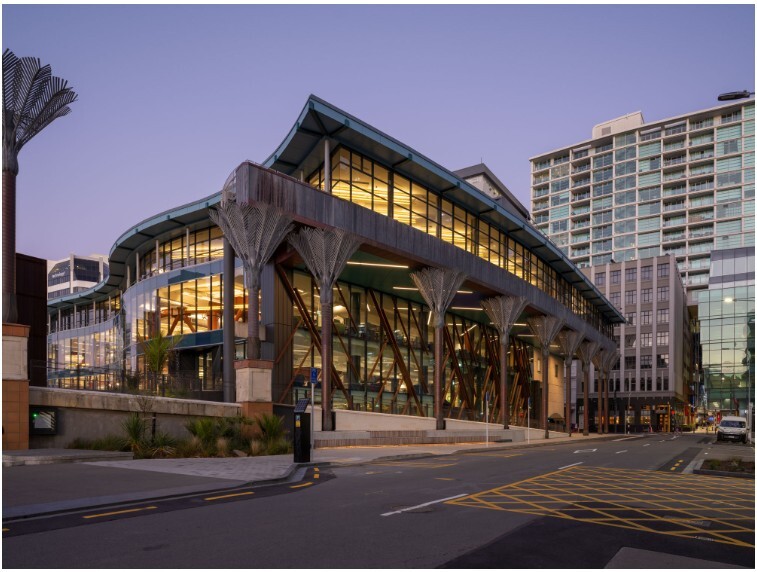
The need for seismic strengthening at Pōneke Wellington’s central library has resulted in bold and beautiful building reuse.
A 5 Star Green Star design rating has been instrumental in the journey.
Essentials
Name: Te Matapihi ki te Ao Nui
What: redeveloped Wellington central library; multi-level structure; 20,400 square metres; accommodates diverse library spaces, WCC Customer Services, WCC Archives, WCC Te Pataka Distribution Centre and Experience Wellington
Name: The window to the wider world; gifted by iwi
Location: Te Ngākau Civic Precinct, central city, close to waterfront lagoon Daily staff occupation: approximately 220 people
Estimated peak library visitors: week days 6000; weekends 10,000
Address: 65 Victoria Street, Pōneke Wellington
Project Snapshot
Building owner: Wellington City Council
Project manager: RCP
Architect + mana whenua design lead: Athfield Architects in association with Tihei Ltd
Structural, civil and services engineers: Aurecon
Project GSAP: Karl Wakelin and sustainability lead for Aurecon
Main contractor: LT McGuinness
Sustainability lead for LT McGuinness: Ben Cannon
Project status: closure 2019; design and construction phase September 2022 to May 2025; completion December 2025; official opening March 2026
Project certification: 5 Star Green Star Design rating (2025)
When the capital city’s landmark library closed seven years ago Wellingtonians had a sense of ‘Where to from here?’
Built in 1991, the much-loved facility - with its iconic nikau palm sculptures across the main entrance - was widely viewed as a cultural epicentre in the CBD.
But expert engineering reports identified the fragility of the building’s hollow-core flooring and the need for seismic strengthening. Closure was unavoidable and a network of central city pop-up libraries replaced it while plans were made.
WCC project director, Paul Perniskie says alongside technical considerations public consultation delivered a clear pathway forward.
“The library was viewed as a significant space in the inner cityscape – a heartbeat – and retention was supported.”
Paul says against the cost of a new build, the retention and reinvention of the existing facility with base-isolation as part of the mix, was relative.
Importantly building reuse amplified with the council’s green agenda – and a 5 Star Green Star certification was at the frontline of the project.
“WCC councillors voted for pushing toward a 5 Star Green Star building with associated actions. Te Matapihi accordingly was an opportunity to demonstrate great green leadership in the city,” says Paul.
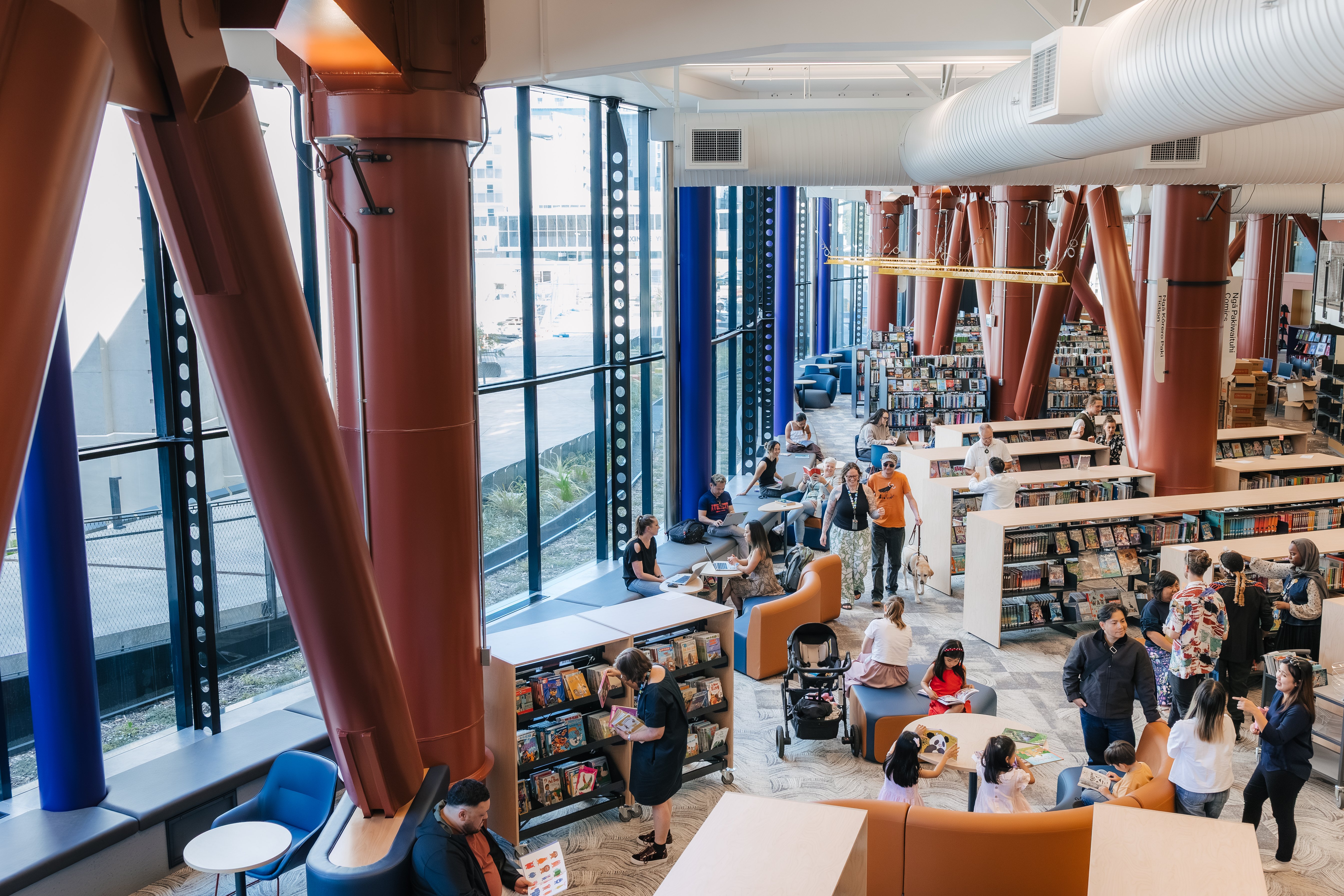
Photo / Wellington City Council
Athfield Architects Ltd principal, Nick Strachan says the ambitious transformation of the old library into Te Mataphi was about “balancing critical urban, heritage and interior parameters while addressing the future of a civic-scaled space.”
He says beyond advanced base isolation technology and building services upgrades, full engagement with mana whenua was paramount and a core part of the client’s brief.
In response a co-design partnership between Athfield Architects and mana whenua design agency Tihei Ltd propelled the project - delivering a unique design language comprising:
- a light-filled and vibrantly coloured interior
- diversity of spaces, textures, materials
- increased area to the public
- the conveyance of mātauranga within the library’s built form
- elements of original heritage fabric juxtaposed with new Rawa – pieces connected to mana whenua including a poem on the building’s exterior
Sustainability lead for LT McGuinness, Ben Cannon, says the project’s most impressive aspect has been “retaining enough of the building’s composition so it’s familiar while updating it to the standard of a new build.”
“Te Matapihi shows the benefits of working a little harder and retaining those significant structures - if you built something from scratch it would be difficult to deliver something this special and it would certainly be a worse environmental outcome.”
He says the sheer scale of retained structure is the biggest green win.
“All the substructure and most of the superstructure and façade was retained so a huge amount of sunk emissions that weren’t landfilled.”
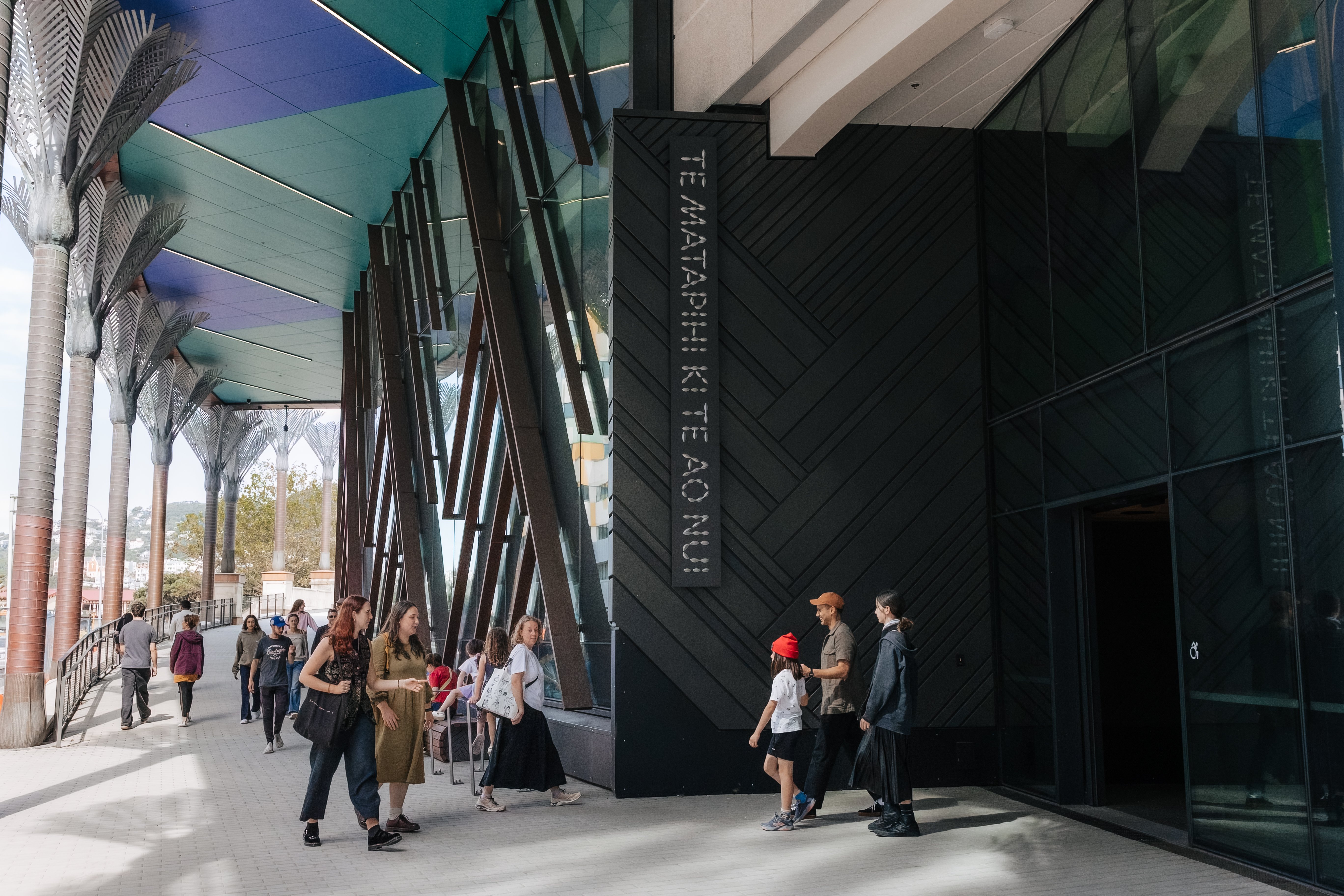
Photo / Simon Devitt
Facts:
- only six percent of the original structure was demolished
- 35 percent of the original façade was removed to improve access, increase natural light, allow for new additions, reduce structural load (removal of heavy precast panels)
- building reuse delivered a 28 per cent reduction in upfront embodied carbon emissions compared to new construction
- across the complete building lifecycle, greenhouse gas emissions were reduced by 51 per cent through reuse and renovation, energy-efficient systems and removal of gas
Ben says the greatest challenge for LTM was the complexity of the structural strengthening within tight internal spaces.
“This included installing base isolators and significant temporary works to support the building while columns were cut – and sourcing a specialist piling rig to operate inside the library’s existing structure.”
Project GSAP, Karl Wakelin from Aurecon, says Green Star elevated the project’s ambitions and outcomes.
Green Star provided:
- a lens of holistic sustainability across energy, water, materials, indoor environment quality, transport and emissions
- a strong mandate for environmentally responsible decisions
- a clear benchmark for best‑practice design, stakeholder engagement, commissioning and operational planning
- a framework for high-level collaboration
Along with:
- embedded ESD principles
- energy modelling; façade performance; HVAC design
- a whole-of-life approach to materials, waste and operational planning
- full electrification; all fossil fuels eliminated including café cooking
- high‑performance envelope upgrades
- Independent Commissioning Agent (ICA) involvement throughout design and construction
- material sustainability targets
- climate adaption planning
Green Star drove innovations and enhancements:
Karl says Green Star acted as a positive driver for quality, performance, market change and accountability.
He says alongside ticking the box for reuse and dramatically reducing embodied carbon the project has conserved the cultural heritage of a treasured public building.
That low-carbon, energy-efficient and comfortable treasured space – merging past and future - is now back in full swing and attracted more than 40,000 visitors during its at opening weekend.
“Heavy utilisation and highly favourable feedback continues reaffirming the importance of Te Matapihi for our city,” says WCC project director, Paul Perniskie.
Other green features include:
• reduced urban heat island effect; a light‑coloured roof reflecting heat not absorbing it; reducing heat gain to the building and localised urban temperatures
• more than 70 percent of the nominated area has a clear line of sight to a high quality internal or external view
• high levels of daylighting
• rainwater reuse system to help reduce potable water consumption
• no new carparks
• reduced light pollution to neighbouring bodies
• 104 public cycle parks in the basement
• 46 dedicated staff cycle parks in the basement and EOT facilities