
For the past two decades, New Zealand's property sector has been focused on improving individual buildings. We've learned how to create healthier offices, more efficient warehouses, better-performing homes and lower-carbon developments.
But increasingly, the question isn't: "Is this building sustainable?"
It's "how does this place work as a community?" And part of this momentum is the realisation that better communities means better places, not just better buildings.
The next evolution is happening at precinct and neighbourhood scale, with the growing popularity of Green Star Communities, a rating tool that assesses projects against a set of distinct social, environmental and economic categories.
The rating tool helps development teams aiming to deliver sustainable communities to:
• provide diverse, affordable, inclusive and healthy places to live, work and play
• protect, maintain and restore the natural environment by reducing developments’ ecological footprints
• receive recognition for demonstrated leadership and commitment to sustainability
• achieve real value for money through demonstrated whole-of-life cost savings
• encourage opportunities for business diversity, innovation and economic development
Projects are rated on a scale of 0-6 Stars with 4 Star considered best practice, 5 Star national excellence, and 6 Star world leadership. It is a tool that covers many aspects of large-scale developments such as precincts, green/brown field developments, neighbourhoods, town centres, urban regeneration projects, and master-planned communities.
What early adopters of Green Star Communities are showing
Franklin Village, a retirement village south of Auckland, was planned from the outset with a holistic focus on community, care, homes and sustainability, welcoming its first residents in January 2026. Developed by Oceania Healthcare, it became the first private sector development in New Zealand to achieve Green Star Communities.
It features:
• Walkable design
• Shared facilities
• Integrated care
• Homestar homes
• Stormwater management
• Biodiversity enhancements
Suzanne Dvorak (CEO, Oceania Healthcare) said its best practice Green Star Communities rating “shows what’s possible when sustainability, care and community are at the heart of your thinking and planning from the very beginning.”
“For us this is about living our purpose of supporting and empowering people to live well as they age and reflects a deliberate approach by Oceania Healthcare to building communities that better support residents over time.”
General Manager of Property and Development Gareth Wright added:
“Franklin Village is a meaningful step forward for the sector. This sets a clear direction for Oceania and provides a benchmark for how retirement villages in New Zealand can support healthier, more connected and more resilient living.”
“Sustainability is built into the way the village and community works”, says Wright.
“This is part of how Oceania Healthcare thinks about creating premium-quality, comfortable homes and communities that genuinely support the people who live in them.”
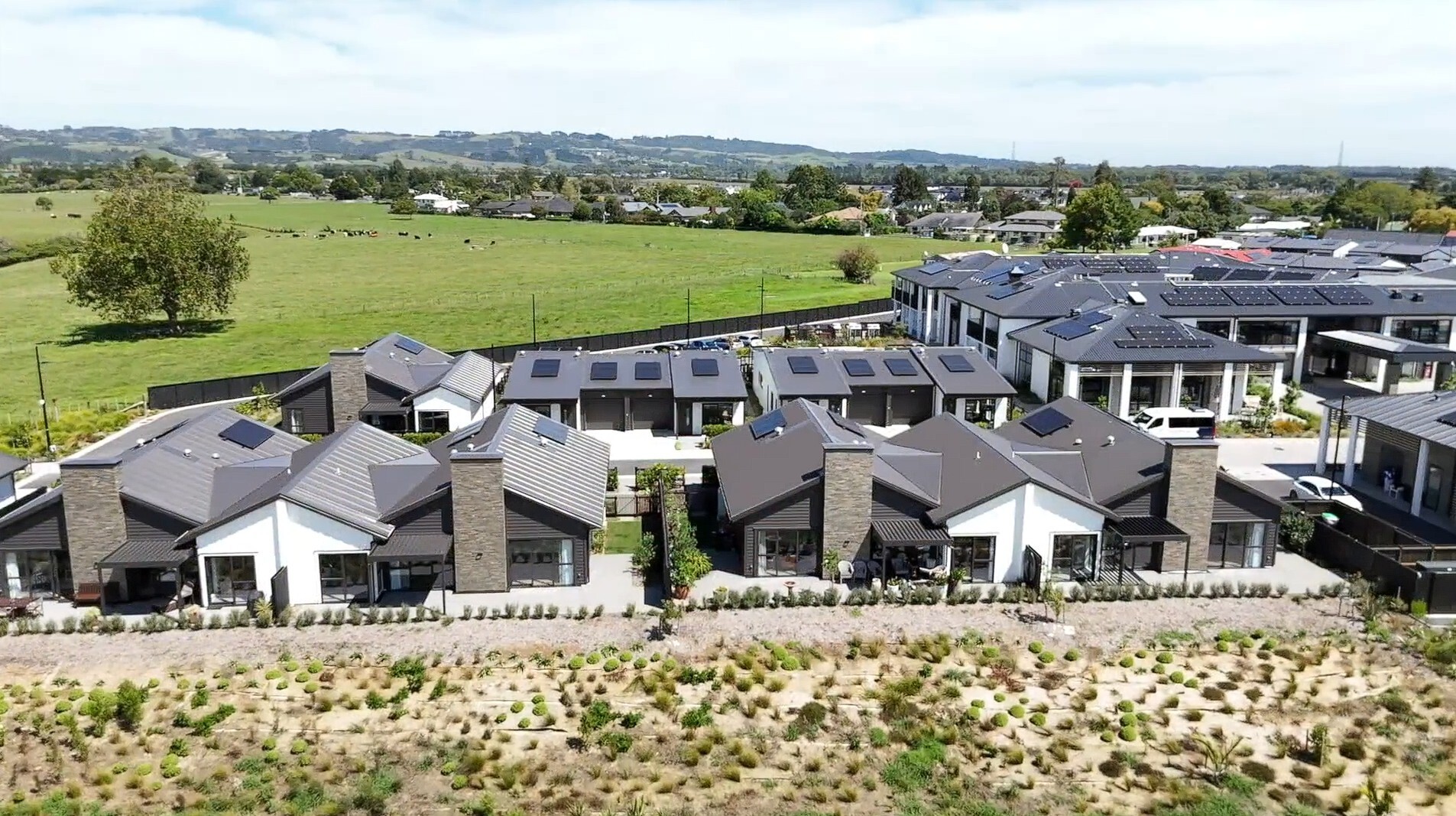
Retirement Village operator Metlifecare was next in line for Green Star Communities certification, for its Ōtau Ridge development, also near Auckland.
It features:
• Native planting
• River corridor
• Walking trails
• Iwi partnership
• Long-term resilience
“We set out to create a community that is sustainable, connected to the local environment and designed for long-term liveability and resilience. Ōtau Ridge has shown what’s possible when a commitment to sustainability and nature is embedded from day one,” said company chief executive Earl Gasparich.
Its 4 Star Green Star certification recognises the best practice sustainability of the whole village, including its landscape, infrastructure and connectivity, as well as its relationship with the surrounding natural environment and its heritage.
Resilience considerations such as flood mitigation, stormwater management and reducing the “heat island” effect were coupled with a commitment to enhance and connect to nature, contribute to biodiversity and improve connections to the community.
Metlifecare worked with the Friends of the Wairoa community group on a riparian planting project to improve biodiversity along the river corridor. More than 26,000 trees, shrubs and plants are being established along the river terrace embankment, riverbank and natural wetland areas. The plants have been eco-sourced from the local Hunua Ecological Region and were chosen to create habitats for native birds and insects, while stabilising riverbanks, filtering stormwater, and improving river health.
“Once fully established along the trail, native shrubs and trees create a green environment that will double as a sanctuary for kererū, tūī, and piwakawaka. For residents, this means every walk is a connection with nature and the story of restoration,” says Metlifecare Development Manager, Cam Roberts.
Natural infrastructure including raingardens and landscaping has been used throughout the village site to help manage stormwater. Rainwater harvesting from rooftops in the village provides practical water resilience.
Creating spaces throughout the village for people to connect with each other, nature and the heritage of the site is another feature of this development. This includes pocket parks and orchards, communal vegetable gardens and a central green space. ESD engineer on the project, Carissa Garcia of Aluntia notes, “The landscaping and rain gardens, the planting along the riverbank, the places to sit outside, these provide tangible examples to the Ōtau Ridge community of how we can build places that contribute to the wellbeing of both people and nature.”
What is needed to achieve Green Star Communities
Green Star Communities assesses projects against a set of five distinct categories:
Governance
This aims to encourage and recognise developers and projects that demonstrate leadership within the sector, by establishing and maintaining strong governance practices. The category promotes engagement, transparency, as well as community and industry capacity building. It also seeks to ensure that community projects are resilient to a changing climate
Economic prosperity
Encouraging and recognising projects that promote prosperity and productivity. The category encourages affordable living and housing, investment in education and skills development, and community capacity building. This category also promotes greater productivity through emerging opportunities in the digital economy.
Liveability
Aims to encourage and recognise developments that deliver safe, accessible and culturally rich communities. This category encourages the development of healthy and active lifestyles, and rewards communities that have a high level of amenity, activity, and inclusiveness.
Environment
This is about reducing the impact of urban development on ecosystems. It encourages resource management and efficiency by promoting infrastructure, transport, and buildings, with reduced ecological footprints. The Environment category seeks to reduce the impacts of projects on land, water, and the atmosphere
Innovation
Aims to recognise the implementation of innovative practices, processes and strategies that promote sustainability in the built environment.
Green Star Communities assesses:
• Precincts
• Neighbourhoods
• Urban regeneration projects
• Retirement villages
• Industrial precincts
Rather than focusing primarily on buildings, it looks at the wider systems that support communities. It rewards good planning, which means that a lot of the work to achieve accreditation is done at the start, with subsequent developments able to then take advantage of infrastructure that’s already been built.
Many developers and councils are already delivering these things, so it can often require little extra work to gain Green Star Communities accreditation.
We have become increasingly sophisticated at measuring building performance. The next step is measuring the quality of the places we create around them. Green Star Communities offers a practical framework for doing just this that.
As more organisations such as Metlifecare, Oceania Healthcare and Tainui Group Holdings embrace the approach, we're seeing a shift from thinking about individual buildings to thinking about complete communities.
Photo / Metlifecare's Ōtau Ridge retirement and aged-care village in Clevedon, near Auckland.