

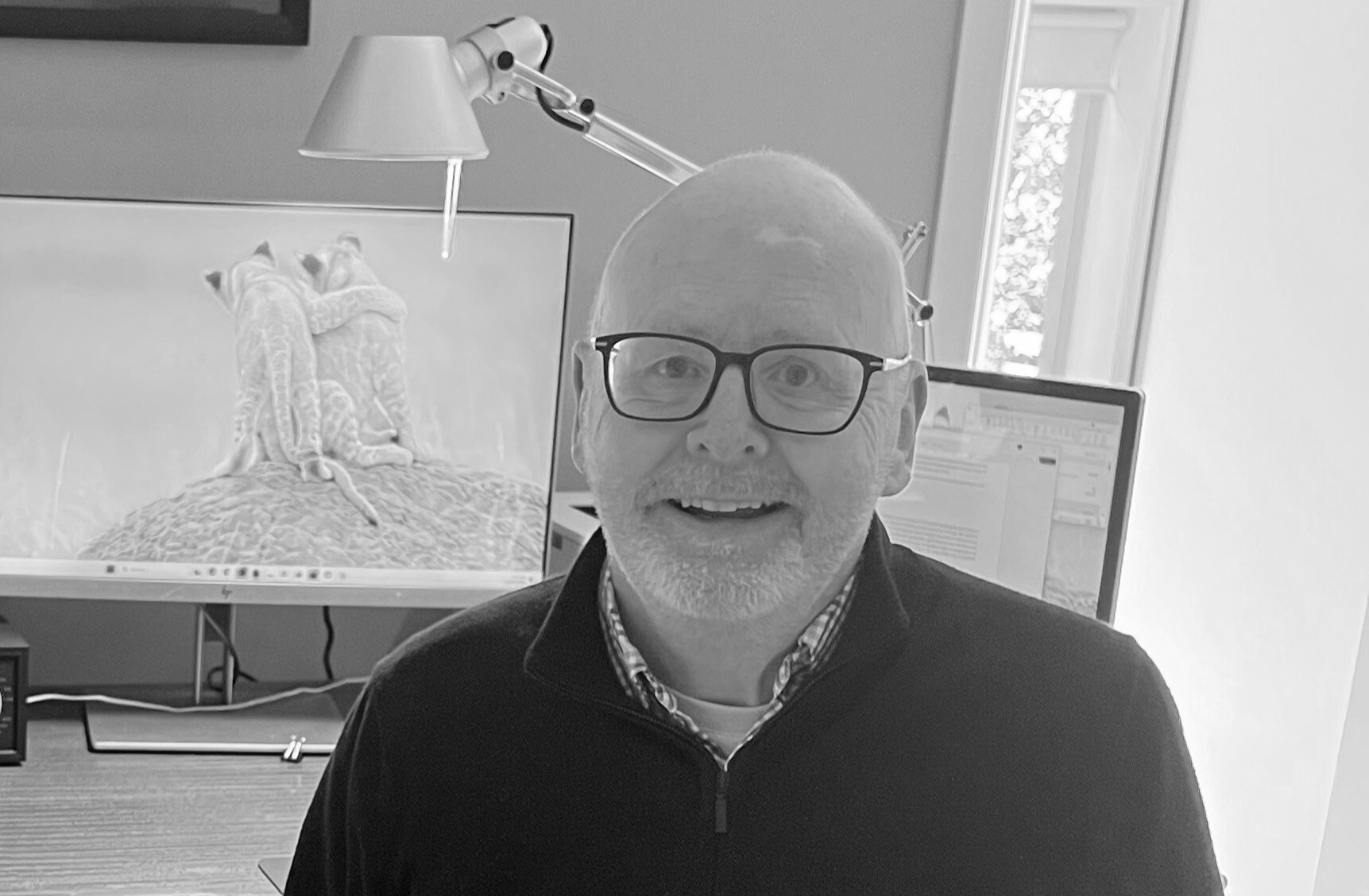
Our Movers and Shakers series spotlights Aotearoa's leading sustainability professionals transforming the way we design, build and operate our buildings and homes. Today we have a special profile of a veteran advocate for sustainable buildings.
David Fullbrook
Industry leader, thinker, collaborator and mentor, David Fullbrook’s career as a building services engineer and sustainable design specialist has been his passion. In this swansong, the eCubed founder shares insights into the industry, politics, AI and advice to those following in his footsteps.
What have been key career accomplishments?
My career with Arup, where I started on graduating in the UK and became Managing Principal in New Zealand, and founding and growing eCubed. Both involved the synthesis and integration of architecture, engineering and sustainability and blurring the edges between them. If you cut my leg off, Arup and eCubed would be found in the tissues!
What milestone changes have inspired you?
More of an evolution than a series of milestones, I like to track this erratic journey against the price of oil in a similar way to the graph in Amory Lovins’ book Natural Capital, which was a mid-career inspiration.
When I started in the 70s we had the first oil shocks and energy-efficient design flourished, then passive design using ambient renewable energies, then the wider considerations of sustainable design, and more recently the imperatives of low-carbon design. Hopefully it will end with regenerative design as we make our reparations in a post fossil-fuel future.
Which projects stand out as beacons of accomplishment?
Briarcliff House in the UK was the first building with an underfloor air-conditioning system and double-skin façade. We had great fun writing bespoke building science algorithms and programs to help design it. I spent the whole fee on analysis!
I led the design and construction of a technically demanding three-bay jumbo-jet maintenance hangar for British Airways, which stood me in good stead for the recent passive design of Hangar 4 for Air New Zealand.
My first project in New Zealand, the Erskine Building, was very challenging, initially collaborating by fax from the UK, then moving with my family across the world to deliver it, with no knowledge of local standards or the market, no support staff or infrastructure. It was an exceptionally brave design to realise.
And more recently, the new BNZ Theatre in Hamilton – the opening night was epic!
What can we demonstrate to other countries?
You only have to look at Beca winning Project of the Year for Building 201 [University of Auckland] and the Building Performance Champion Award at the recent CIBSE Awards in London – we can lead as well as follow. Think global, act local.
What can we take from international practices and apply here?
Skills and standards are more transferable than ever. Our industry continues to be refreshed by skilled people as part of increasingly international careers. My son Jonathan is currently working for Foster + Partners in London on incredible projects. That cross-fertilisation will help the wider cause of sustainability globally.
What key government policy changes would assist green-building outcomes?
Climate-change mitigation and adaptation needs to a long-term, non-partisan consensus that underpins the policies of governments of all colours. There’s too much ego, spin and negativity in our politics. It [climate action] doesn’t seem to feature for any of the major parties coming into the election, so I was glad to see the NZGBC release its Election Manifesto 2026.
What advancements would rapidly progress the industry?
There is a lack of long-term critical thinking. We are prisoners to the boom-bust cycle. I don’t see any other jurisdiction around the world that designs and builds the way we do. It takes far too long and the relative cost of construction is far too high. Sustainability becomes a nice-to-have rather than an essential. We also have very poor building standards and regulation.
The architectural and engineering academic and professional institutions struggle to provide relevant qualifications and training for what I would define as multi-disciplinary building engineering and building science. To cope with challenges such as climate change, AI and demographic change, we need a wider perspective.
In our last conversation, you mentioned the 1970s fuel crisis. How much does this one differ in our preparedness?
We have become part of an interconnected global economy and a supply chain underpinned by our reliance on fossil fuels. We over consume and have lost our self-sufficiency and resilience. It’s incredible to me that with such resources and natural capital we are not self-sufficient in food and energy supply.
How is AI impacting what you do?
The way we draw, document, analyse, measure performance and rate will be replaced by machine learning. This frees up the engineer and architect to concentrate on the measures that matter. We will be able to do more than we have ever done and faster. It could be like a treadmill or liberating – it’s too soon to tell.
It’s not yet time to replace Andrew Eagles with a chatbot! But I can see a time when AI processes becomes embedded rather than peripheral.
What are you looking forward to when you step away from work?
A few years back I developed a two-hour lecture for the University of Auckland tracing the history of environmental design – from pre-history through to Vitruvius, the industrial revolution to modern day. I was inspired by the work and publications of Reyner Banham, Dean Hawkes and George Baird. I’d like to write a new version of Banham’s The Architecture of the Well-Tempered Environment.
I’m also keen to develop a new services typology for mass-timber buildings. I’d like to bring together structural engineering, fire engineering, services engineering and architecture to form a more coherent, integrated whole. Collaborators welcome – a bit of fun!
David’s advice for young professionals:
What’s your advice to a young person embarking on a career in your industry?
• Structure your career around core principles and values that are important to you and will guide you. Mine have coalesced around leadership, imagination, collaboration, perseverance and humanity.
• In a rapidly changing world, don’t specialise, become a generalist.
• A successful career is about combining your IQ and EQ to its greatest potential.
• Collaborate with those who complement what you do best. Double acts are often more powerful and influential than trying to do everything yourself. My son Conor [Director & Hydraulic Consultant, eCubed] has been a long-term collaborator.
• Starting with a smaller practice or company can be good as you tend to be fast-tracked in opportunity and experience. It doesn’t surprise me that the graduates we train go on to do great things in larger firms.
• Develop a culture of lifelong learning and career development. At the start of each year think about five new skills or products that you could learn.
• Build a long-term professional cohort – not just on LinkedIn! In New Zealand I’ve had the privilege of working with a number of sustainability movers and shakers, including Trish Love, Warner Brunton, Patrick Arnold, Quentin Jackson, Ben Masters, Paul James, Amanda Bryan, Jo Woods, Ella Osborne, Helen Zhou, Anton Smith, Sarah Daniell, Kaito Paetz and Carissa Garcia-Richards. We share a common sustainability DNA.