
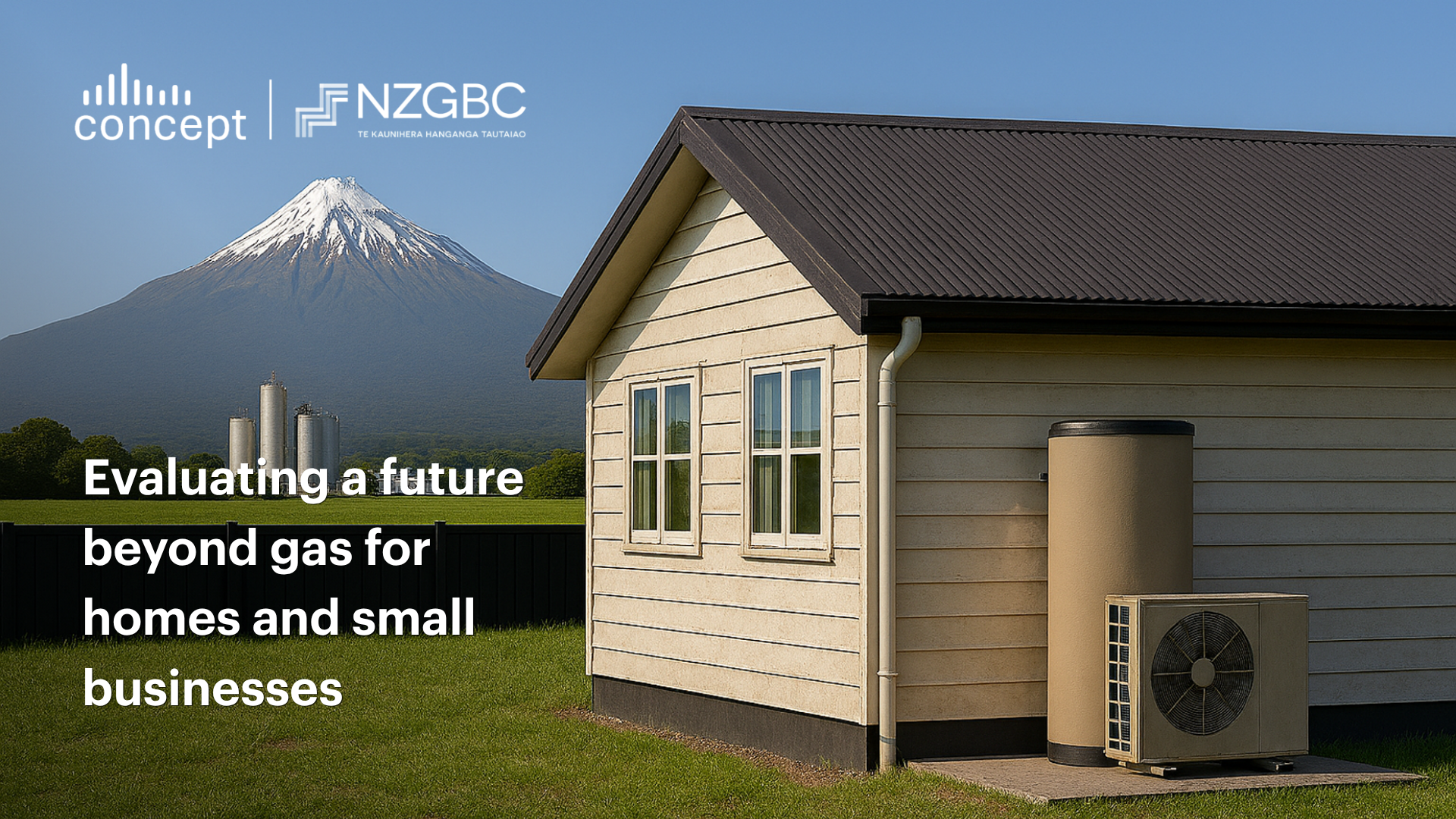
Kiwi households and small businesses stand to save thousands of dollars by moving away from piped natural gas towards more efficient electric technologies, according to new research released today by the New Zealand Green Building Council (NZGBC).
The report, Evaluating A Future Beyond Gas for Homes and Small Businesses, was prepared by Concept Consulting and finds the economics have now swung decisively in favour of electricity as natural gas supplies decline and gas prices rise.
For the vast majority of households, replacing gas heating and hot water systems with electric alternatives such as heat pumps is now one of the most profitable investments that can be made.

The research found a typical new build household would save approximately:
- $17,260 over 15 years by using a heat pump rather than gas for space heating
- $15,900 over 15 years by using a hot water heat pump instead of gas water heating
NZGBC Director of Market Transformation Sam Archer said switching away from piped natural gas now makes good financial sense for most households and small businesses.
“The technology has improved dramatically, the running costs stack up, and the long-term savings are significant,” he said.
"This isn't about forcing people to make changes. It's about helping households make informed decisions as appliances reach the end of their life and need replacing. This is being done successfully around the world — we need to get started here.”
Switching a typical medium heat-load household to a heat pump delivers around a 17% return and increases household wealth by around $9,000 over 15 years, with water heating delivering similar returns.
(Examples of upfront cost of a hot water heat pump in a medium sized new build home is $8280 compared with $6740 gas and $3,180 for electric resistance/ traditional cylinder.)
Across the range of household circumstances the average return on switching is 20–50% — one of the most profitable investments a household can make.
The report estimates that transitioning homes and small businesses away from piped gas by 2050 would deliver around $7.1 billion in economy-wide benefits, including lower energy costs, reduced health impacts and avoided greenhouse gas emissions.
For new homes, the findings are unequivocal. Electric systems are the lowest-cost option in every scenario.
Sam Archer said the findings present a significant opportunity for New Zealand.
"The biggest barrier isn't technology. It's that most households don't have the time or information needed to undertake a detailed financial assessment of their future gas and electricity costs."
"The evidence shows many households would benefit from switching, but they need clearer signals and practical support to help them make that decision when appliance replacement opportunities arise."
The research points to Victoria, Australia, as an example of how governments can support consumers to transition. Rather than banning existing appliances, Victoria has focused on clear long-term planning, targeted incentives, building standards and trade workforce development.
Removing gas from homes and buildings also helps release it for industries that cannot yet electrify, saving jobs saving jobs in manufacturing and industry.
Since early 2023, average household gas bills have increased by around 36 per cent in real terms, while electricity prices have risen by only around 5 per cent. Gas prices are projected to keep increasing while the cost of electric heating is expected to fall.
The NZGBC is calling for a pragmatic and measured approach that includes:
- Clear long-term signals about the future role of residential gas
- Building standards that make electricity the default choice in new buildings
- Workforce training and support, including transition pathways for gasfitters
- Protection against future pipeline decommissioning costs being unfairly borne by remaining consumers
- No new homes connected to the gas network
- Targeted support for low-income households and renters
See NZGBC’s Election Manifesto 2026
Importantly, the report focuses solely on reticulated (piped) natural gas supplied to homes and small businesses. It does not cover LPG cylinders, barbecue gas, or outdoor gas heating.
Annie Jefferson, General Manager of Wairarapa’s A2W Hot Water Heat Pumps and a leading advocate for household electrification and energy-efficient hot water systems said the research findings matched what she was seeing in the market.
“Around 95% of the work we do now is taking households off gas. One of the biggest drivers we’re hearing from customers is the increase in fixed daily gas charges,” she said.
“People are looking at what they’re paying just to remain connected before they’ve even used any gas and questioning whether it makes sense anymore. That certainly supports what the report says about the economics of remaining on the gas network as customer numbers and volumes decline.”
The research was reviewed by Professor Alan Brent of Te Herenga Waka Victoria University of Wellington and Christian Hood, Chief Advisor at the New Zealand Climate Foundation.
More NZGBC energy research: